
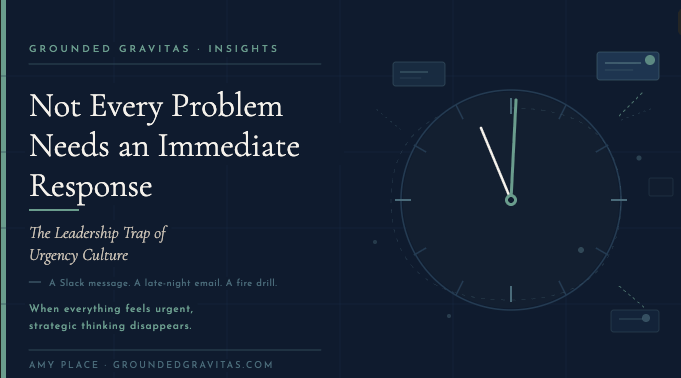
Not Every Problem Needs an ImmediateResponse:The Leadership Trap of Urgency Culture
A Slack message goes unanswered for 12 minutes.
A late-night email receives no immediate reply.
A minor operational issue is escalated as a fire drill.
Meetings multiply. Decision cycles compress. Everyone moves faster.
And slowly, urgency becomes the culture.
In many organizations, responsiveness is mistaken for leadership effectiveness.
But there is a hidden cost.
When everything feels urgent, leaders lose the cognitive conditions required for strategic thinking, sound judgment, and high-quality decision-making.
The result is not higher performance.
It is organizational reactivity.
What Urgency Looks Like in Practice
I once observed a leadership team spend nearly an hour responding to an issue that ultimately required no immediate action.
The conversation moved quickly. Emails were exchanged. Additional meetings were scheduled.
Everyone appeared productive.
Yet no one paused long enough to ask the most important question:
Is this actually urgent?
The issue eventually resolved with additional information that became available the following day.
What consumed the team’s attention was not the problem itself.
It was the discomfort of uncertainty.
This is how urgency culture often operates. Activity increases, but clarity decreases.
The Neuroscience of Constant Urgency
The human brain is not designed to operate in a continuous state of perceived threat.
Research shows that chronic stress and constant interruption impair executive functioning, working memory, emotional regulation, cognitive flexibility, and decision accuracy.
Under sustained pressure, leaders often experience:
Reduced cognitive flexibility
Narrower strategic thinking
Increased emotional reactivity
Greater reliance on habitual responses
Stronger confirmation bias
Over time, immediacy begins to replace effectiveness.
And organizations unintentionally reward it.
Why Urgency Culture Feels Like High Performance
Urgency culture often looks productive on the surface:
Rapid responses
Constant availability
Packed calendars
Endless escalation
Quick decisions
Perpetual busyness
But speed and effectiveness are not the same thing.
Research in organizational psychology consistently shows that cognitive overload and excessive job demands impair decision quality, increase burnout risk, and reduce long-term performance.
The issue is not occasional urgency.
The issue is sustained organizational hyperarousal.
When urgency becomes normalized, thoughtful leadership is gradually replaced by reactive management.
The Organizational Cost of Urgency Culture
Declining Decision Quality
Constant pressure reduces cognitive bandwidth and increases reliance on emotionally driven or habitual decision-making.
Leaders become more likely to:
React prematurely
Miss strategic risks
Overlook downstream consequences
Default to short-term solutions
Burnout and Cognitive Fatigue
Continuous urgency prevents meaningful recovery.
Over time, chronic stress contributes to emotional exhaustion, reduced concentration, diminished resilience, and declining performance sustainability.
Communication Breakdown
Urgency cultures often create:
Fragmented communication
Emotional contagion
Reduced listening quality
Defensive interactions
People stop thinking critically and start reacting reflexively.
Innovation Suffers
Strategic thinking requires cognitive space.
When every issue is treated as urgent, creativity, adaptive problem-solving, and long-term thinking begin to decline.
Psychological Safety Erodes
When urgency dominates culture, employees become less likely to:
Ask questions
Challenge assumptions
Admit uncertainty
Raise concerns early
The result is increased operational and reputational risk.
Why Leaders Fall Into the Urgency Trap
Many executives were rewarded for urgency early in their careers.
Fast responses were interpreted as:
Commitment
Competence
Reliability
Ambition
Over time, urgency can become identity-driven rather than strategically necessary.
Leaders begin equating slowing down with underperforming.
But leadership effectiveness is not measured by how quickly someone reacts.
It is measured by the quality, clarity, and long-term effectiveness of their decisions.
Five Ways Leaders Can Reduce Organizational Reactivity
1. Distinguish Urgent from Important
Not every issue requires an immediate response.
Create clear distinctions between emergencies, operational priorities, informational requests, and perceived urgency.
2. Protect Thinking Time
High-quality decisions require uninterrupted cognitive space.
Normalize strategic thinking time, fewer meetings, and asynchronous communication.
3. Create Decision-Triage Frameworks
Categorize decisions by:
Urgent vs. important
Reversible vs. irreversible
Strategic vs. operational
This reduces unnecessary escalation and emotional reactivity.
4. Reward Decision Quality
Organizations often reward responsiveness rather than effectiveness.
Evaluate leaders based on clarity, judgment, communication, and sustainable execution—not perpetual availability.
5. Increase Awareness of Cognitive Load
Executives often recognize operational overload before they recognize cognitive overload.
Leadership development should include:
Stress awareness
Emotional regulation
Decision-making under pressure
Cognitive fatigue recognition
Nervous system regulation
Disciplined Calm Is a Leadership Advantage
The strongest leaders are not always the fastest responders.
They are the leaders who can remain clear, regulated, and strategically focused when pressure rises.
Because in an urgency culture, the greatest competitive advantage may no longer be speed.
It may be the ability to think clearly while everyone else is reacting.
Final Reflection
Organizations invest heavily in strategy, operations, and financial planning.
Yet many of the most consequential business outcomes are shaped by something far more fundamental:
The conditions under which leaders make decisions.
When urgency becomes the culture, leaders risk confusing movement with progress and activity with effectiveness.
Not every problem requires immediate action.
Sometimes the most strategic response is the ability to pause long enough to think clearly.